How to Cool a Warehouse in Summer: AC, Fans & More
Keeping a warehouse cool during the summer months can be a challenge. This is especially true in poorly ventilated spaces where machinery, lighting and high staffing levels contribute to rising indoor temperatures. The result: discomfort, reduced productivity and even damage to stored goods. So how can you counteract these issues and maintain a stable temperature?
In this guide, we’ll explore how to cool a warehouse efficiently, including the best mechanical systems you can put in place. Plus some extra tips from our experts! Read on to learn more.
Why do warehouses get so hot?
If you’re struggling with a warehouse that’s too hot in summer (and potentially too cold in winter), you’re not alone! These industrial buildings are prone to temperature fluctuations for the following reasons:
- Poorly insulated walls and roofing – often built from concrete and steel
- Limited ventilation and stale air circulation
- Cool air escaping (or heat entering) through large loading bay doors
- High staffing levels – often in a condensed area
- Large amount of items being stored (reducing airflow)
- Heat-generating equipment or machinery
With that in mind, the best way to cool a warehouse is to prevent heat from entering and improve airflow. You can also use targeted cooling systems where they’re needed most.
How to cool a warehouse: three options
1. Industrial fans
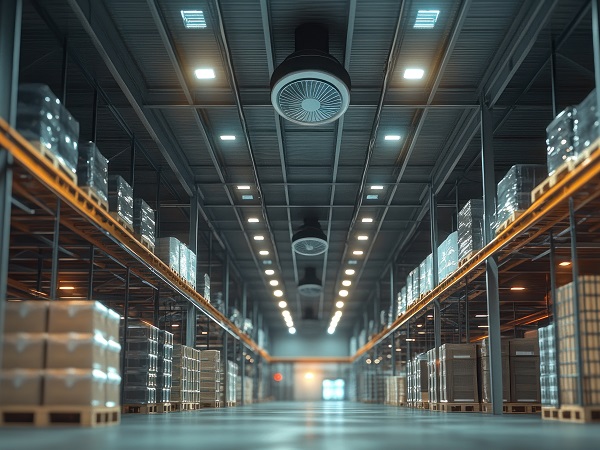
For businesses on a tight budget, industrial ceiling fans can be an effective first step in cooling down a warehouse. High Volume, Low Speed (HVLS) ceiling fans are particularly well-suited to large spaces. They are capable of moving huge volumes of air to improve ventilation and minimise hot spots. And, as they are ceiling-mounted, these fans won’t be obstructed by shelving and other obstacles. They’re also simple to install and relatively cost-effective to run.
But it’s important to remember that fans won’t significantly lower the temperature of your warehouse. They simply move the air already inside the building around to promote better airflow. As such, they work best in combination with ceiling vents which enable heat to escape. You may also need smaller fans or portable air conditioners to cool individual workstations.
2. Warehouse air conditioning
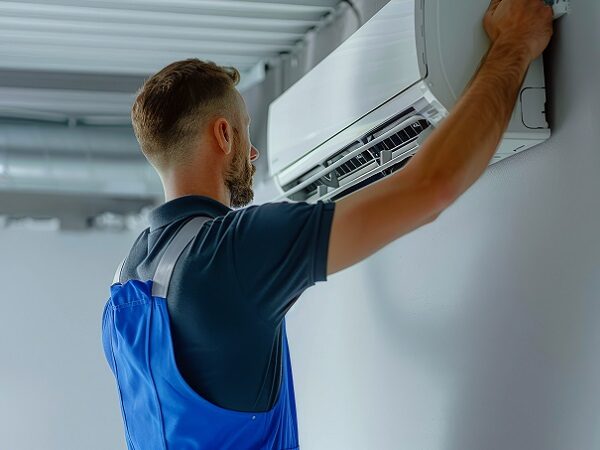
Air conditioning offers precise temperature control which is particularly useful in spaces where temperatures need to remain consistent. Most AC systems also reduce humidity and filter out dust and airborne particles – a major advantage in industrial settings. They are also highly effective in smaller spaces, which is where zoned air conditioning can prove useful. For example, around packing stations, in office rooms and goods storage areas.
However, air conditioned warehouses do have a number of downsides. Namely, installing a full-scale AC system that covers your entire unit would likely prove very costly. Both to fit and to run! With that in mind, warehouse air conditioning only really works in individual zones. It may therefore make more sense to use portable AC units where they’re needed most instead.
The other problem is that air conditioners work best in sealed environments. So, if you’re frequently opening your warehouse’s roller shutters to accept deliveries or despatch goods, it won’t work as effectively. So what’s the alternative?
3. Evaporative cooling system
More sustainable and cost-effective than traditional air conditioning, evaporative cooling is the best way to cool a warehouse in summer. These systems work by drawing in outside air and passing it over water-saturated cooling pads. This water then evaporates and creates cool air to circulate throughout the building. This way, you can enjoy a continuous supply of fresh air.
Evaporative cooling systems are also more energy efficient, using just 10-20% of what AC requires! And they don’t use refrigerants that may harm the environment either. Plus, they are ideal for large warehouse spaces as their efficiency isn’t impacted by open doors or shutters.
The only real disadvantage of evaporative cooling is that it is slightly less effective in humid environments. However, newer two-stage systems are suitable for use in a range of settings.
Smart design for better warehouse cooling
Want more ideas for cooling down a warehouse? Beyond mechanical technology, you should assess your warehouse’s ventilation, layout and insulation quality. Here are some simple steps you can take to improve the temperature of your unit:
- Install screen doors or PVC strip curtains to help keep cool air from escaping and warm air getting in at entry points. (These will also help to reduce draughts in winter).
- Use programmable thermostats and occupancy sensors to make sure your cooling systems only run as needed. Systems that automatically adjust to changes are best!
- Insulate your walls and ceilings, and consider painting the roof white to reflect the sun’s heat. If you have skylights or windows too, try a reflective coating to block rays.
- Avoid clutter around air vents and cooling equipment to ensure good airflow.
- Turn off unused machines and lights to reduce unnecessary heat generation.
- Ventilate your warehouse at night – open screened vents to allow cooler air in when outside temperatures drop. Or leave your ventilation system running so that your cooling system doesn’t have to work as hard when starting up the following day.
Custom warehouse cooling solutions
There’s no one-size-fits-all approach when it comes to cooling down a warehouse. The right solution will depend on factors like the size of your space and its layout. Not to mention its level of insulation and how your warehouse is used on a daily basis.
With that in mind, our experienced engineers will first assess your building to identify any airflow or temperature control issues. From there, we can recommend the most effective way to cool your warehouse, or a combination of options as appropriate.
From fans to vents, evaporative coolers to air conditioning units, we can supply and fit reliable systems by Mitsubishi, Panasonic and Fujitsu. Or we can design a bespoke, energy-efficient solution for your warehouse based on your business’s needs and budget restraints.
Once installed, we can also provide ongoing maintenance and repairs across Manchester and the North West. Contact us today for an initial estimate or to book a routine service online.
Speak to a HVAC expert today
Enter your details below to get a call back from one of our HVAC experts.